DoorDash Cuts Grocery Reorder Latency from 16 to 2 Seconds with AI Agents
DoorDash reduced grocery reorder latency from 16 to 2 seconds using batch LLM inference, doubling shopping list views and boosting order rates by 34 percent.
By Dillip Chowdary • Oct 31, 2026 • Source: InfoQ
At a glance
- Latency
- 16 seconds down to 2 seconds
- Flow order rate
- up roughly 34 percent
- Shopping list views
- doubled
- Direct edits
- no language model call needed
DoorDash cut latency in its AI-powered grocery reorder flow from 16 seconds to 2 seconds by precomputing recurring purchase needs, as reported by InfoQ's report. The shift removes repetitive large language model generation from the live interactive path by predicting replenishment orders in offline batches. By precomputing candidate baskets, DoorDash doubled shopping list views and increased flow orders by approximately 34 percent.
This report details how DoorDash restructured Ask DoorDash, its conversational shopping assistant, to balance offline predictive inference with deterministic catalog resolution. It is written for engineering leaders and AI architects evaluating production agent deployments. The piece examines how DoorDash separated purchase reasoning from live inventory checks, grounded its user interface, and accelerated internal agent development across domain teams.
01What actually changed
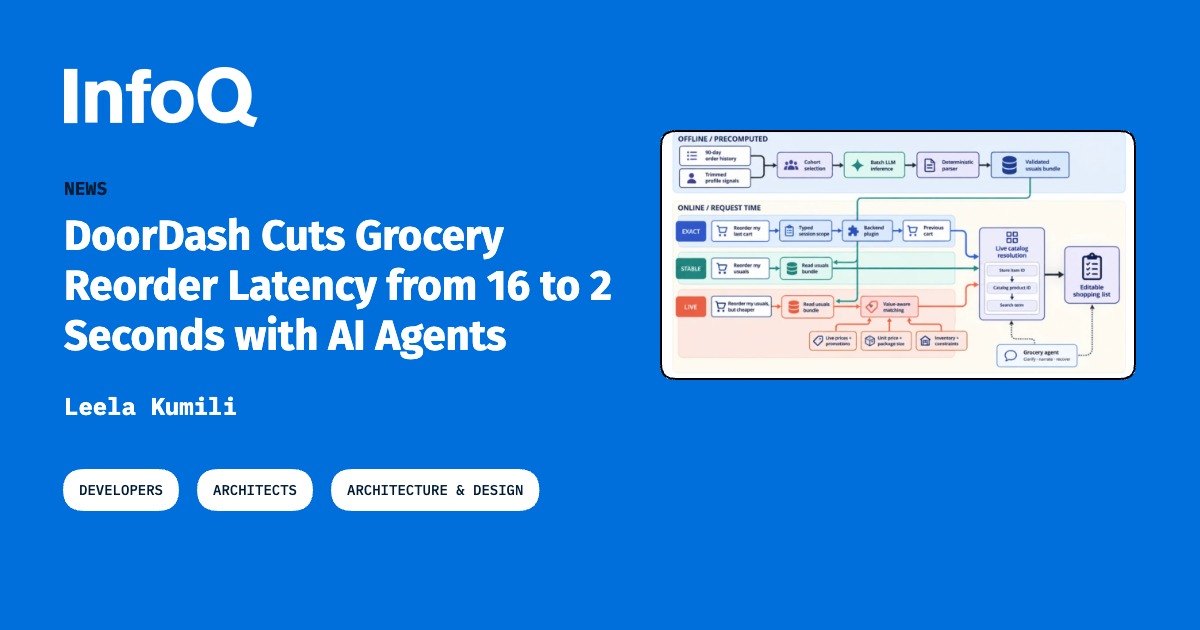
Under the previous architecture, Ask DoorDash executed model generation directly on the serving path whenever a customer initiated a grocery reorder request. The system ingested past orders, inferred repurchase intent, searched store catalogs, and built candidate baskets during the live session.
That synchronous pipeline forced shoppers to wait around 16 seconds before seeing recommendations, creating friction. DoorDash eliminated this runtime bottleneck by decoupling historical basket formulation from live consumer requests, replacing on-demand generation with precomputed candidate lists cached for retrieval and immediate display.
Deterministic validation checks then verify the generated results before storing reusable shopping list data. When a user subsequently enters the grocery flow, the serving path retrieves the prepared list in two seconds instead of sixteen. This eightfold latency reduction doubled shopping list views and increased the flow order rate by roughly 34 percent.
Deterministic validation checks then verify the generated results before storing reusable shopping list data. When a user subsequently enters the grocery flow, the serving path retrieves the prepared list in two seconds instead of sixteen. This eightfold latency reduction doubled shopping list views and increased the flow order rate by roughly 34 percent.
02How it works
If that item is unavailable, it searches for a matching catalog product identifier. If that lookup fails as well, the serving path queries inventory using a fallback search term. This cascading resolution accommodates inventory fluctuations, changing merchant listings, and out-of-stock items without repeating historical language model reasoning during live user requests.
If that item is unavailable, it searches for a matching catalog product identifier. If that lookup fails as well, the serving path queries inventory using a fallback search term. This cascading resolution accommodates inventory fluctuations, changing merchant listings, and out-of-stock items without repeating historical language model reasoning during live user requests.
When shoppers interact with their cart, a grounded shopping interface lets them modify lists directly. Operations like changing product quantities or removing items update the list without triggering language model calls. The specialized Grocery agent is invoked only for complex requests requiring deeper reasoning, such as finding cheaper alternatives based on current prices, active promotions, package sizes, inventory, and dietary preferences.
When shoppers interact with their cart, a grounded shopping interface lets them modify lists directly. Operations like changing product quantities or removing items update the list without triggering language model calls. The specialized Grocery agent is invoked only for complex requests requiring deeper reasoning, such as finding cheaper alternatives based on current prices, active promotions, package sizes, inventory, and dietary preferences.
Advertisement
Tech Pulse Daily
Get tomorrow's pulse first
Join engineers who read Tech Pulse before stand-up. Free, weekday mornings.
03Why it matters now
Conversational shopping interfaces frequently suffer from high latency that dampens user engagement during checkout workflows. Twisha Jain, an engineer at DoorDash, highlighted the core design philosophy on LinkedIn, explaining that better agentic systems are not always about more reasoning, but about deciding what belongs in the agent loop and what can happen ahead of time. While other grocery platforms like Instacart deploy artificial intelligence to assist with meal planning, list creation, and product discovery, DoorDash focused directly on reducing reorder latency by separating historical purchase analysis from live catalog resolution.
The implementation highlights how shared infrastructure improves engineering velocity across an enterprise. By consolidating orchestration, memory, tracing, and model evaluation into a centralized platform, DoorDash enables specialized teams to spin up domain agents rapidly.
The company reported that adding its Reservations agent took only one week, which was approximately ten times faster than building its initial domain agents. Decoupling deterministic catalog resolution from generative reasoning reduces live inference costs while allowing domain teams to innovate on specialized skills without managing redundant foundational systems.
04Who is affected
Shoppers can modify the precomputed list directly, adjusting quantities or removing items without conversational lag. As DoorDash explained in an engineering post regarding the shopping interface, a consumer direct edit is authoritative, meaning the next agent turn starts from the edited list rather than conversational remarks. These interface improvements contributed directly to doubling shopping list views.
Shoppers can modify the precomputed list directly, adjusting quantities or removing items without conversational lag. As DoorDash explained in an engineering post regarding the shopping interface, a consumer direct edit is authoritative, meaning the next agent turn starts from the edited list rather than conversational remarks. These interface improvements contributed directly to doubling shopping list views.
Instead, teams define domain-specific instructions, skills, and tools on top of the shared platform. This separation of responsibilities allowed the Reservations team to ship an agent in seven days, demonstrating how reusable infrastructure reduces development overhead. Platform engineers retain control over rollout safeguards and tracing, ensuring that runtime optimizations benefit multiple domain applications simultaneously without duplicating code.
Instead, teams define domain-specific instructions, skills, and tools on top of the shared platform. This separation of responsibilities allowed the Reservations team to ship an agent in seven days, demonstrating how reusable infrastructure reduces development overhead. Platform engineers retain control over rollout safeguards and tracing, ensuring that runtime optimizations benefit multiple domain applications simultaneously without duplicating code.
05What to watch
The success of DoorDash grocery reordering demonstrates a practical model for commercial agentic design: treating user interface artifacts as shared, structured state rather than relying solely on conversational text history. By treating the shopping list as an independent data structure that both users and agents can directly manipulate, platforms can bypass unnecessary model calls entirely. Observers should track whether competing retail platforms adopt similar grounded interfaces that give precedence to direct user edits over chat context, establishing standard conventions for combining graphical controls with autonomous agent systems.
Technical teams will also monitor how effectively offline batch inference handles volatile merchant inventories over time. Because batch predictions process ninety days of purchase history prior to live requests, the three-tier catalog resolution path must reliably bridge gaps caused by out-of-stock items, price shifts, and discontinued store listings. In addition, observers will watch how DoorDash expands its shared agent platform across new transactional verticals, assessing whether the rapid one-week deployment pace achieved with the Reservations agent can be sustained as agent tools and operational constraints grow more intricate.
Frequently asked questions
How did DoorDash reduce grocery reorder latency from 16 to 2 seconds?
DoorDash shifted recurring purchase analysis from the live request path into offline batch large language model inference. The system precomputes candidate replenishment lists from ninety days of order history and resolves items against live store catalogs at runtime.
What impact did the lower reorder latency have on consumer behavior?
The eightfold latency reduction doubled total shopping list views across the platform. In addition, the grocery reorder flow order rate increased by approximately 34 percent.
How does the system handle out-of-stock items or price changes?
The serving layer uses a three-tier catalog resolution sequence that first matches the store item, then the catalog product identifier, and finally a fallback search term. Complex substitutions like finding cheaper alternatives invoke the specialized Grocery agent directly.
What role does the grounded shopping interface play in reducing model calls?
The interface treats the shopping list as a structured artifact where consumer edits, such as changing quantities or deleting items, update the list directly without language model calls. Any subsequent agent turn treats the consumer direct edit as authoritative.
Sources

Author
Dillip Chowdary
Writes Tech Bytes coverage of AI, engineering, and the tools that actually ship. Editor of Tech Pulse Daily.
Related on Tech Bytes
Advertisement